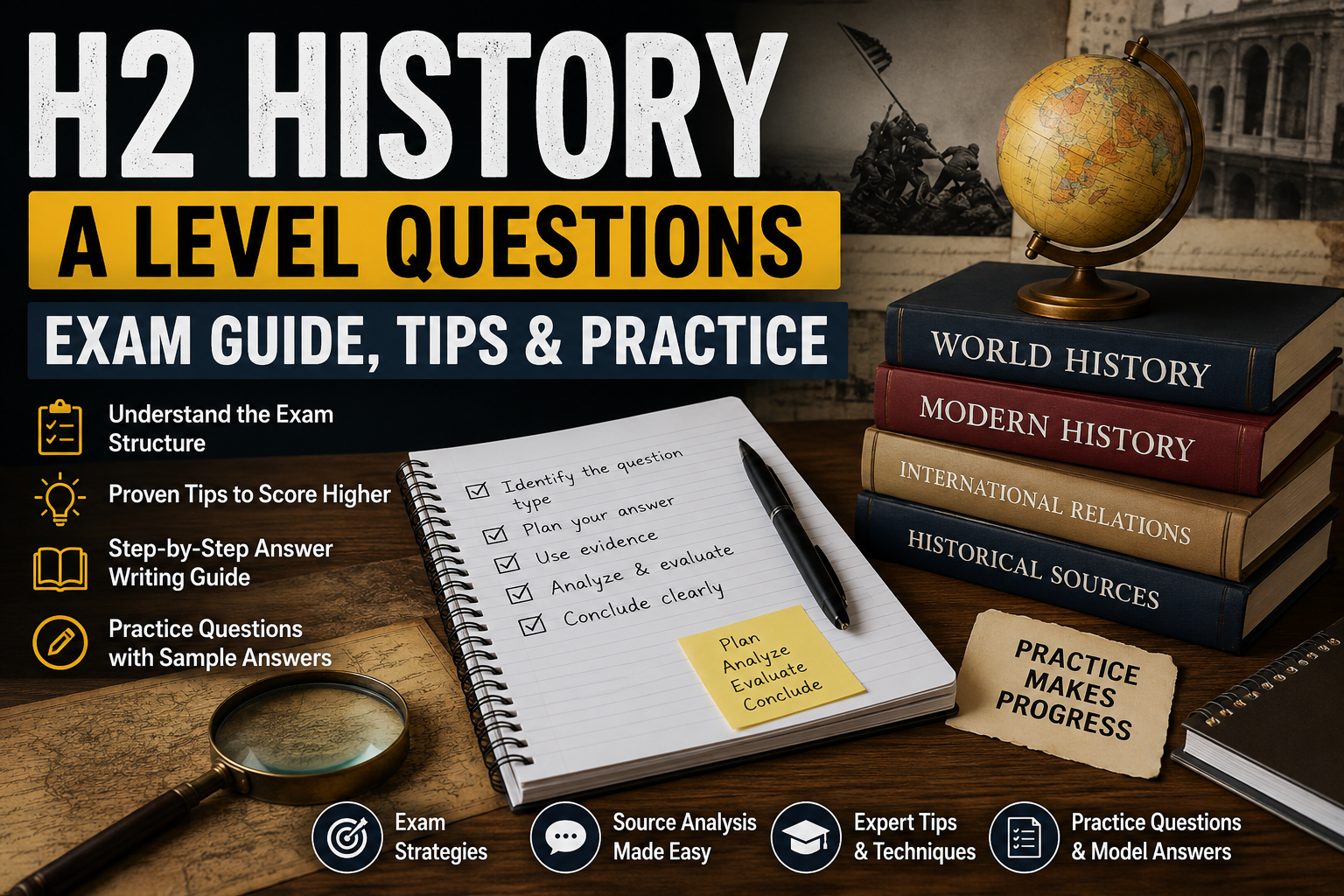
The process of preparing to take H2 History A-level questions isn’t easy at first, particularly when the syllabus is a mix of complex historical issues, multiple interpretations and arguments based on evidence. In contrast to subjects that concentrate primarily on memorizing and recall, the H2 History demands students examine the historical context, consider various perspectives, and formulate solid arguments in the context of examination conditions. This is why preparing for the exam is as crucial as knowing the what is historical.
Students who consistently do excellently in H2 History have more to do than go through textbooks. They are aware of the format for their exam and are able to write analytical essays, analyze sources of historical significance and gain confidence to respond to questions within a strict time frame. It doesn’t matter if you’re studying months prior to the test or seeking efficient strategies for revision closer to the exam Understanding the way you can prepare for H2 History questions are designed can dramatically enhance your performance.
Understanding H2 History A Level Questions
It is built to assess more than facts and knowledge. Examiners require students to demonstrate the ability to think critically, demonstrate historical reasoning, the ability to evaluate sources and the ability to create well-balanced arguments backed by evidence.
Many questions in the examination will require students to look at the cause of an issue and historical events and evaluate their significance or consider different interpretations of historical events. Instead of requiring candidates to remember dates or names by themselves Examiners reward students who are able to identify the reasons why historical events took place in the first place, how they influenced subsequent developments, and if alternative views are equally persuasive.
This method of analysis helps make this approach to analysis makes H2 History an extremely stimulating A Level subjects.
Why Understanding Question Types Matters
One of the most common mistakes students make is that they prepare by studying notes. While knowledge of content is still important, knowing the format of H2 A Level History questions will help students understand the expectations of examiners.
Every question is accompanied by instructional words which indicate how the answer will be created. The words such as assess evaluate, compare, clarify the extent to which and then discuss all require different approaches to analyze. Understanding these words allows students to construct more robust responses and prevents them from drifting from the central argument.
The most successful candidates take time to understand the demands of each question prior to beginning their answer.
Building Historical Arguments
A successful success with H2 History answers are built on simple, logical arguments instead of isolated facts. Historical evidence should back the argument rather than replace it.
Each paragraph should be focused on one idea at a time and introduce evidence relevant to the topic that explains its significance and then connect it to the main topic. This results in a cohesive discussion which demonstrates knowledge and analytical skills.
The most ardent responses also recognize the possibility of different viewpoints when needed, but and explain the reasons why one interpretation might seem more credible than the others.
Developing Strong Source Analysis Skills
Questions that are based on sources remain a crucial part of H2 History tests. These tests test the student’s ability to understand the historical evidence, rather than recalling details from memory.
Students should be able to discern the source, intent and context, as well as the reliability and weaknesses of every source. Instead of accepting every assertion as factual successful students should consider the reasons the source was written and the way that historical events could influence the contents.
Effective source evaluation integrates close reading with broader knowledge of the past and allows students to write convincing and balanced analyses.
Time Management During the Examination
Even students who are well-prepared can be challenged when they spend a lot of time preparing their answer. This is why time management is an essential skill for exam preparation.
Before tackling each question you should spend a few moments in identifying the main issue as well as organizing evidence and deciding on an appropriate sentence structure. A plan that is clear often leads to a better-focused answer, and decreases the chance of repeating.
Giving yourself enough time to look over your work will also help find faulty explanations, false claims, or even small writing mistakes that can impact the overall quality.
Common Challenges Students Face
Many students are aware of history but struggle to translate that knowledge into exam answers that score high. Certain answers are more descriptive than analytical, while other responses contain massive amounts of facts without describing its significance.
Another issue that is common is focusing on only one aspect of a discussion. Because many H2 History questions require balanced evaluation, students need to be aware of the different perspectives before coming to a solid conclusion.
The development of these higher-order thinking skills requires constant practice instead of revising at the last minute.
Effective Revision Strategies
Quality revision is focused on understanding the relationships between events in history instead of learning particular facts. Making timelines, comparing various historical interpretations, as well as reviewing previous exam questions can help build understanding over time.
Practice under timed conditions boosts confidence and prepares students for the demands of the real test. Examining feedback from the teacher after each essay practice allows students to pinpoint weak points that are repeated and to gradually improve both the structure and analysis.
Repetition over a period of time generally results in more effective results than intense study prior to the exam.
Conclusion
Making preparations for H2 A-level questions in History requires commitment, analytical thinking, and consistent writing exercises. Students who are able to combine solid historical knowledge with efficient exam techniques are more able to write concise solid, balanced and based on evidence-based responses.
Instead of focusing on memorizing historical facts successful students learn to analyze questions in a thoughtful manner in order to make convincing arguments, analyze historical evidence, and express ideas clearly. Through consistent practice and careful revision, H2 history becomes not just manageable, but also an extremely enjoyable subjects to master.
Leave a Reply