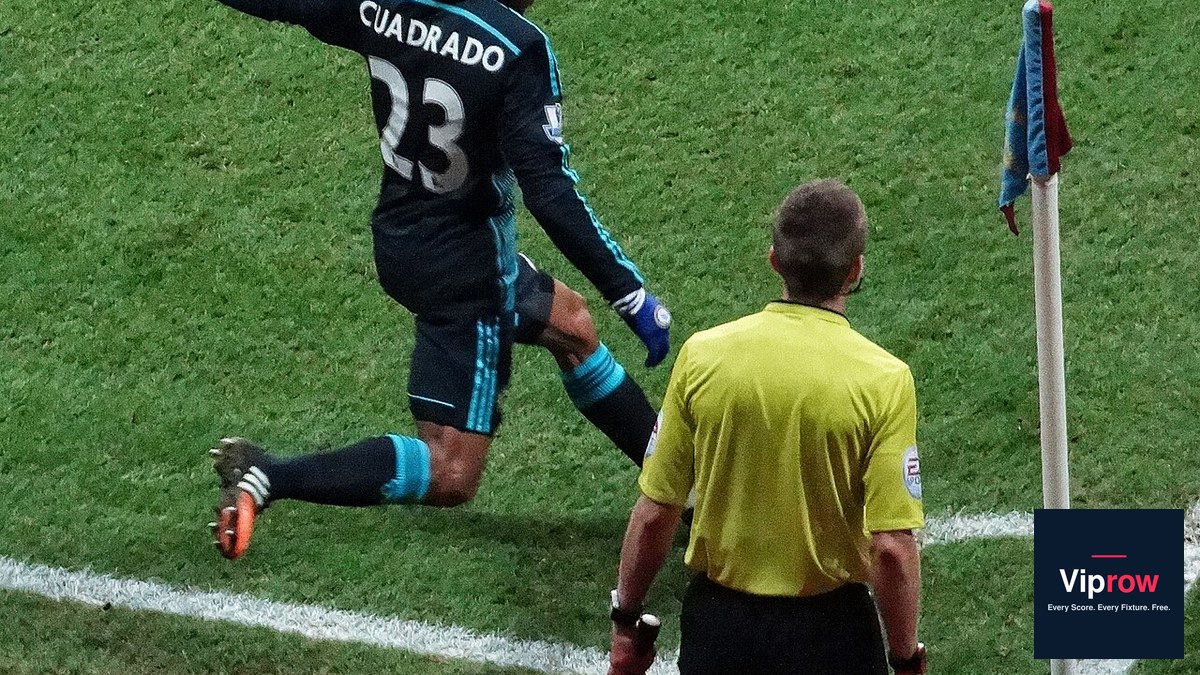
Football corners decide matches every single week. A towering header wins a cup final, and a clever short corner unlocks a packed defence. Yet many fans still ask simple questions. When is a corner given? Can a player score straight from one? Why do teams crowd the six-yard box? This guide explains football corners in plain English. It follows the Laws of the Game from the International Football Association Board (IFAB).
What Is a Football Corner?
A football corner is a restart from the corner of the pitch. It happens when the ball crosses the goal line without a goal being scored. The attacking team takes the kick from the corner arc nearest to where the ball left the field. The ball is placed inside the arc, and the kicker strikes it back into play.
Corners are a type of set piece. A set piece is a planned restart, such as a free kick or a throw-in. Teams practise corners in training because they create goals. Roughly one in every 40 corners leads to a goal in top-level football, so even a small edge matters. Many clubs now hire set-piece coaches. Their only job is to design routines for corners and free kicks.
When Is a Football Corner Awarded?
A corner is awarded when the ball wholly passes over the goal line. Two conditions must both be true. First, the ball must have last touched a player from the defending team. Second, no goal must have been scored. If the last touch came from an attacker instead, the restart is a goal kick.
The decision belongs to the referee and the assistant referee. The assistant watches the goal line closely and signals with a flag. If the ball crossed the line after a defender blocked a shot, the flag points to the corner. Then the referee confirms the decision, and play restarts with a corner kick.
Note that the whole ball must cross the line. If only part of the ball is over the line, play continues. The same rule applies to goals, throw-ins and goal kicks. Modern goal-line technology helps the referee judge close calls at the highest level.
The Corner Kick Rules Explained
The corner kick rules are short and clear. First, the ball must be placed inside the corner arc. The kicker may place any part of the ball inside the arc, but the ball must not move. Second, opponents must stay at least 9.15 metres (10 yards) from the corner arc until the ball is in play. Third, the corner flagpost must stay in place.
The ball is in play as soon as it is kicked and clearly moves. The kicker must not touch the ball again until another player has touched it. If the kicker touches it twice, the referee awards an indirect free kick to the other team. A goal can be scored directly from a corner kick against the opponents. However, if the ball goes straight into the kicker’s own goal without touching anyone else, the other team is awarded a corner kick.
The Corner Arc and Ball Placement
Every corner of the pitch has a quarter-circle arc. The arc has a radius of one metre from the corner flagpost. It marks the area where the ball must be placed. The flagpost itself stands at least 1.5 metres high, and it must not have a pointed top. Players may not move the flag to gain extra room.
The kicker can place the ball anywhere inside the arc. Some kickers push it to the edge to widen the angle. Others keep it close to the flag to curl the ball in tightly. This choice matters. A ball placed on the outer edge gives the kicker a straighter line to the far post. Meanwhile, a ball tight to the flag suits an inswinging delivery.

Can You Score Directly From a Football Corner?
Yes, a player can score directly from a corner. This rare goal has a special name: the Olympic goal. It is also called a gol olimpico in Spanish-speaking countries. The first famous Olympic goal was scored by Cesáreo Onzari of Argentina against Uruguay in 1924. The goal gave the feat its name because it came soon after Argentina had won the Olympic football title.
An Olympic goal is hard to score. The ball must bend sharply from a tight angle and beat the goalkeeper at the near post. Most goalkeepers guard the near post well, so direct attempts often fail. For that reason, most teams aim for a team-mate instead.
Why Direct Corner Goals Are So Rare
Direct corner goals are rare for two reasons. First, the angle is extremely tight, so the ball must curl a long way to reach the goal. Second, the goalkeeper expects the danger and covers the near post. He stands close to the post and watches the ball closely. If the kick is too slow, he catches it with ease. If the kick is too strong, it flies past the far post.
How Attacking Football Corners Work
Attacking corners follow a plan. The taker chooses a target zone, and the runners time their movement. Most teams crowd the six-yard box with tall players. The aim is simple. Win the first header, then either score or flick the ball on to a team-mate at the far post. Timing is vital. If runners move too early, defenders track them. If they move too late, the ball passes them by.
Teams use signals to pick the routine. The taker may raise one hand or two hands before the kick. Each signal means a different delivery, such as near post, far post or penalty spot.
Inswinging Corners
An inswinging corner bends towards the goal. A right-footed player takes it from the left side, or a left-footed player takes it from the right side. The curve pulls the ball towards the goalkeeper, and that makes it dangerous. Defenders struggle to clear it because the ball moves away from them. However, the goalkeeper can claim it if he comes off his line at the right time.
Outswinging Corners
An outswinging corner bends away from the goal. A right-footed player takes it from the right side, or a left-footed player takes it from the left side. The curve carries the ball towards the penalty spot, where attackers run onto it with power. Outswingers are easier for attackers to attack, since they can run towards the ball and meet it with pace. Many teams prefer outswingers for this reason.

Short Corners and Quick Corners
A short corner is a pass to a nearby team-mate instead of a cross into the box. The taker plays the ball to a player standing close to the corner arc. That player then crosses it, dribbles past a defender, or passes it back for a shot. Short corners work best against teams that pack the box with tall defenders. They pull defenders out of position and create a better angle for the cross.
A quick corner is different. It is taken fast, before the defence is ready. The taker restarts play as soon as the ball is placed, while defenders are still walking back. This can catch a team off guard. However, the risk is high. If the defence is alert, the chance is wasted.

Near-Post and Far-Post Routines
The near-post routine is the most common corner plan. An attacker makes a sharp run to the near post and flicks the ball on. The flick can score directly, or it can reach a team-mate at the far post. This routine works because the near-post run is short and hard to defend.
The far-post routine is the opposite. The taker aims the ball deep, towards the back post. Tall players gather there and attack the ball as it drops. This plan suits teams with height, since a far-post header is hard to stop from close range. Some teams combine both ideas. One player attacks the near post, while another waits at the far post for the flick-on.
Defending Football Corners: Zonal Marking
Zonal marking means defenders guard a zone, not a player. Each defender stands in a set area of the penalty box. When the ball arrives in his zone, he attacks it. The system is organised and simple to coach. Every player knows his spot, so gaps are easy to spot in training.
The main weakness is the second ball. If the first clearance drops to an attacker on the edge of the box, no defender may be close enough to block the shot. Zonal marking also needs brave defenders. A player must attack the ball even when an opponent runs at him. If he stands still and waits, the attacker wins the header.
Defending Football Corners: Man-to-Man Marking
Man-to-man marking means each defender picks up one attacker. He follows that player everywhere in the box until the ball is cleared. This system is direct and easy to understand. Every attacker has a marker, so no one is left free. Teams with strong, physical defenders often prefer it, since a good marker can stop a header by staying tight.
The weakness is movement. Attackers use blocks and decoy runs to lose their markers. One attacker may block a defender while another runs free. Then the free player meets the ball unchallenged. Man marking also risks fouls, because tight marking leads to pushing and holding. Referees watch this closely and can award a penalty.
The Goalkeeper’s Role at Football Corners
The goalkeeper is the most important defender at a corner. He must decide in a split second whether to stay on his line or come for the cross. If he comes, he must claim the ball cleanly. If he stays, he must guard his goal and react to shots. This choice decides many corner goals. A keeper who comes and misses leaves an open goal behind him.
Most goalkeepers start near the centre of the goal, slightly towards the far post. From there, they can see the ball and the runners. They call out to their defenders and organise the marking. A loud keeper makes the whole defence better. He tells players where to stand and warns them about runners. If the ball drops close to him, he must punch or catch it with both hands.

Common Corner Kick Mistakes and Fouls
Many corners fail because of simple mistakes. The most common error is a poor delivery. A cross that is too high flies over everyone, while a cross that is too low is cleared by the first defender. The taker must hit the right height and pace. Another mistake is bad timing. Runners who move too early are marked, while runners who move too late miss the ball.
Fouls are common too. Defenders who hold or push attackers risk a penalty, and referees now check corners closely with video review. Learn how video checks affect these calls in How VAR Works in Football: Checks, Decisions and Controversies Explained. Another error is the double touch. If the taker touches the ball twice before another player touches it, the referee gives an indirect free kick to the other team.
Key Takeaways on Football Corners
Football corners follow clear rules. A corner is given when a defender last touches the ball before it crosses the goal line. The ball must sit in the corner arc, and opponents must stay 9.15 metres away. A goal can be scored directly from a corner, though this Olympic goal is rare. The kicker must not touch the ball twice, and the flagpost must stay in place.
Attacking teams choose between inswinging and outswinging deliveries, near-post flicks, far-post headers, short corners and quick corners. Each plan suits a different team. Defending teams pick zonal marking, man-to-man marking, or a mix of both. The goalkeeper organises the defence and decides when to claim the cross. Corners are a small part of the game, yet they decide big matches.
Corners are one of several restarts every fan should know. Read How Football Substitutions Work: Rules, Five Subs and Concussion Replacements Explained. See How Football Free Kicks Work: Direct, Indirect and the Wall Explained. Read How the Offside Rule Works in Football Explained in Plain English. Read How Football Penalty Shootouts Work: Rules, Order and Sudden Death Explained. See the IFAB Laws of the Game.
3 thoughts on “How Football Corners Work: Rules, Tactics and Set-Piece Secrets Explained”