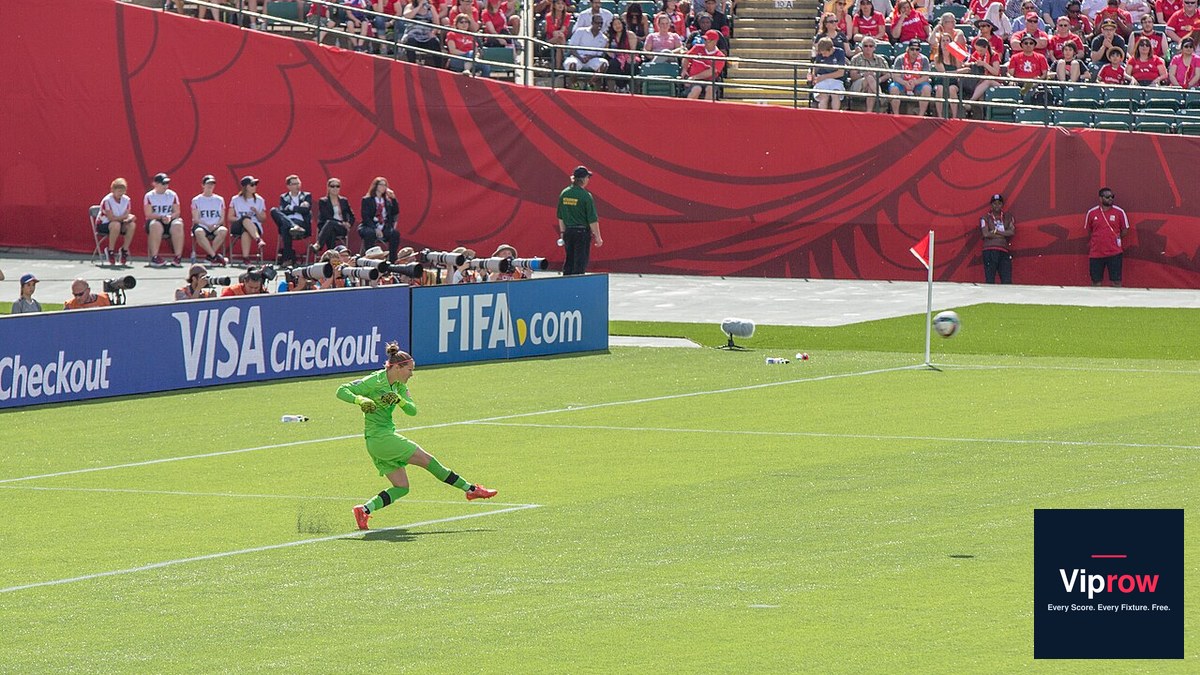
1. What a Football Goal Kick Is
A football goal kick is the restart that gets play going again after the ball has crossed the goal line without a goal. It belongs to the defending team, and it is taken from inside the goal area. Most of the time the goalkeeper takes it, but the rules do not say it must be the goalkeeper.
Every match has several goal kicks. Some think the ball must leave the penalty area before anyone can touch it. Others think only the goalkeeper can take it. Both ideas are wrong under the current Laws of the Game.
The full official text sits in Law 16, and you can read it on the IFAB Laws of the Game page. This guide explains that law in plain English, step by step.
2. When a Goal Kick Is Awarded
A goal kick is awarded when the whole ball passes over the goal line, on the ground or in the air, having last touched a player of the attacking team, and no goal is scored. The key point is the last touch. If an attacker shoots wide, the defending team gets a goal kick.
Part of the ball over the line is not enough. Play stops only when the whole ball has crossed the line. The referee then points down towards the goal area to show that a goal kick will follow.
A goal kick can also follow a restart that cannot score directly. If an indirect free kick goes straight into the goal without touching anyone else, no goal is given. The defending team restarts with a goal kick instead.
3. Goal Kick or Corner Kick: How to Tell
The difference is simple: who touched the ball last? If an attacker touched it last, the defending team gets a goal kick. If a defender touched it last, the attacking team gets a corner kick.
The last touch decides
A defender who blocks a shot and sends it behind the goal gives away a corner. An attacker who shoots wide gives the other team a goal kick. The last touch decides the call, even if the touch was small or by accident.
Why fans mix the two up
Both restarts follow the ball crossing the goal line, so fans mix them up. The referee’s arm clears up the doubt. A downward point means a goal kick, and an upward point towards the corner arc means a corner. Our guide to how football corners work explains the corner kick in full.
4. Where the Ball Is Placed
The ball must be stationary, and it must be kicked from any point within the goal area. The goal area is the smaller box in front of the goal, often called the six-yard box. It stretches six yards out from the goal line and six yards to each side of the goalposts.
Next, the taker does not have to place the ball on the side where it went out. If the ball crossed the line on the left, the goalkeeper can still take the kick from the right side of the goal area. Many goalkeepers do this to set up a pass to a team-mate.
Finally, the ball must sit on the ground and must not move before the kick. A ball that rolls as the taker strikes it means the kick must be retaken.
5. Who Can Take a Goal Kick
Any player of the defending team can take a goal kick. The Laws of the Game do not say the goalkeeper must take it. In practice, the goalkeeper takes almost every goal kick, because the goalkeeper has the strongest kick. But a defender can step up instead.
A team might use an outfield player for a good reason. A defender with a long, accurate pass might take the kick to reach a tall forward quickly. The choice is tactical, not a rule.
Still, the taker must kick the ball. A goalkeeper cannot pick the ball up and throw it out as a goal kick. The ball must be kicked from the ground, and the kick must make the ball clearly move.
6. When the Ball Is in Play
The ball is in play when it is kicked and clearly moves. That is the whole test. The ball does not need to travel far, and it does not need to leave the penalty area. A short pass to a team-mate inside the penalty area puts the ball in play at once.
This rule changed in 2019. Before that change, the ball had to leave the penalty area before it was in play, and a team-mate could not touch it inside the area. The new rule opened the door to the short goal kicks most teams now use to build play from the back.
For defenders, the change matters too. An opponent who rushes in and touches the ball before it is in play has broken the rules, and the goal kick is retaken. But once the ball has been kicked and clearly moves, opponents can press at once.

7. Short Goal Kicks: Playing Out From the Back
A short goal kick is a pass to a team-mate close by, usually a defender or midfielder who has dropped deep. The aim is to keep the ball and build an attack from the back. Most top teams now use short goal kicks as their first choice.
The short goal kick works best when receivers spread out and offer clear passing lanes. One defender moves wide, another drops to the side of the goal, and a midfielder comes short to link the play.
Why teams take the risk
Playing out from the back carries risk, because a mistake near your own goal can lead straight to a chance for the other team. Yet teams accept that risk for a clear reason. A short goal kick keeps possession, and possession lets a team control the game.
When a short kick goes wrong
The danger is real. If a defender receives the ball under pressure and loses it, the other team can shoot at once. Every player must know where to stand. If no team-mate is free, the goalkeeper should go long instead.
8. Long Goal Kicks: Going Direct
A long goal kick sends the ball high and far up the pitch, usually towards a tall forward. The aim is to gain ground fast. Teams use it when the other team presses high, or when the short options are all marked.
Good technique matters here. The goalkeeper must strike through the ball with power and height, so it travels far and stays in the air long enough for a team-mate to get under it. A weak or low kick can be cut out by an opponent.
Long kicks also give the other team a chance to win the ball. A forward who wins the first header can flick it on, but a defender who wins it can start a counter attack. For that reason, many teams treat it as a backup plan. Still, with a tall striker who wins headers, it can be a strong weapon.
9. Opponents at a Goal Kick
Opponents must stay outside the penalty area until the ball is in play. Opposing players can only enter the area once the ball has been kicked and clearly moves.
There is one fair exception. If an opponent is inside the penalty area when the goal kick is taken because they did not have time to leave, the referee allows play to continue. The opponent has done nothing wrong if they could not get out in time. They must not get involved in play before the ball is in play.
An opponent who enters the penalty area early on purpose breaks the rules. If that player touches the ball or challenges for it before the ball is in play, the referee orders a retake. If the player fouls an opponent while entering early, the goal kick is still retaken, and the offender can be cautioned or sent off.

10. Can You Score Directly From a Goal Kick?
Yes, a goal can be scored directly from a goal kick, but only against the opposing team. If the goalkeeper kicks the ball the full length of the pitch and it bounces over the other goalkeeper and into the goal, the goal counts. It is rare, but the law allows it.
The rule has one clear limit. A goal cannot be scored directly into the kicker’s own goal from a goal kick. If the ball goes straight into the kicker’s own goal without touching another player, no goal is given. Instead, the other team is awarded a corner kick.
That corner kick rule surprises many fans, but it follows a simple idea. A team should not be punished with an own goal from its own restart when no opponent has touched the ball.
11. Offside and the Goal Kick
There is no offside offence when a player receives the ball directly from a goal kick. Under Law 11, it is one of three restarts where offside does not apply on the direct receipt. The other two are the throw-in and the corner kick. So a forward can stand beyond the last defender and still be onside at that moment.
This rule lets attacking teams use the long goal kick as a weapon. A fast forward can start high, take the ball from a long kick, and run towards goal. The defender cannot rely on the offside trap at that instant.
The protection ends once the ball has been touched by another player. After that first touch, the normal offside rule applies again. A forward beyond the last defender can then be caught offside on the next pass. Read our guide to how the offside rule works in football for the full picture.
12. What Happens If the Kick Goes Wrong
If the ball is moving when it is kicked, or the kick is taken from outside the goal area, the referee orders the goal kick to be taken again.
The second touch rule
The kicker must not touch the ball again until it has touched another player. If the kicker takes the kick and then touches the ball a second time before anyone else has touched it, the other team is awarded an indirect free kick. This can happen when a goalkeeper plays a short goal kick and then picks the ball up again.
Handball by the kicker
If the kicker handles the ball on that second touch, the restart is a direct free kick, or a penalty kick if the offence is inside the kicker’s own penalty area. If the kicker is the goalkeeper, though, the restart is an indirect free kick instead. Our guide to how football free kicks work explains the difference between direct and indirect free kicks.

13. Time-Wasting, the Five-Second Countdown and Common Mistakes
Under the 2026/27 Laws, time-wasting at a goal kick is dealt with firmly. If a player unfairly delays the taking of a goal kick, the referee whistles and signals a five-second countdown with a raised hand.
If the goal kick has not been taken by the end of the five seconds, a corner kick is awarded to the opposing team. That is a heavy price for delay. The countdown starts only when the referee decides the team is delaying.
The eight-second rule is different
Fans often mix the five-second countdown with the eight-second goalkeeper rule. The eight-second rule applies when a goalkeeper holds the ball in their hands during play. If the goalkeeper keeps it past eight seconds, the other team gets a corner. The five-second countdown applies to a delayed goal kick.
Common mistakes to avoid
Players take the kick from outside the goal area, or kick a moving ball. Opponents creep into the penalty area too early. Kickers touch the ball twice, or goalkeepers pick up a short goal kick before a team-mate has touched it.
A fresh player can change the next phase too, so it helps to know how football substitutions work. Video checks can also review big moments, as our guide to how VAR works in football explains. When the ball goes out over the touchline, our guide to how football throw-ins work covers that restart. Keep these rules in mind next time your team takes a goal kick, and the restart will make much more sense.
1 thought on “How Football Goal Kicks Work”