
Yellow and red cards are the referee’s clearest tools in football. A yellow card is a warning. A red card ends a player’s match. Yet many fans still ask why one foul earns a yellow, while a similar foul earns a red. Therefore this guide explains the full system in plain English.
What Yellow and Red Cards Mean in Football
The system is simple. A yellow card communicates a caution. A red card communicates a sending-off. In other words, yellow means “you have been warned”, while red means “leave the field now”. The referee holds the card above the head, so everyone can see the decision.
Under Law 12, only a player, a substitute, a substituted player or a team official may be shown a yellow or red card. The referee can act from the pre-match inspection until leaving the field after the match ends. A caution lasts for the rest of that match, while a sending-off ends the player’s game at once.
A Short History of Yellow and Red Cards in Football
Cards have not always been part of football. Before 1970, referees gave cautions and dismissals by word of mouth. Players sometimes claimed they had not heard the referee. Therefore football needed a visual signal that every player could understand.
The idea came from English referee Ken Aston, who took the colours from traffic lights. Yellow would warn, and red would stop. The system was first used at a World Cup in 1970, and it soon spread through the game. Today, cards are used at every level, from the World Cup final to a Sunday league match. For more on the basic rules, read our plain English guide to how the offside rule works in football.
What Is a Yellow Card in Football?
A yellow card is a formal caution. It tells a player that their behaviour has crossed a line, but the offence is not serious enough for a sending-off. The player stays on the field. However, the warning is real. A second yellow card in the same match brings a red card.
A yellow card can be shown for a foul, but it can also be shown when the ball is out of play. For example, a player can be cautioned for dissent during a break in play, or for delaying a restart. In short, misconduct can happen at any time. That is an important difference from a foul, which can only happen while the ball is in play.
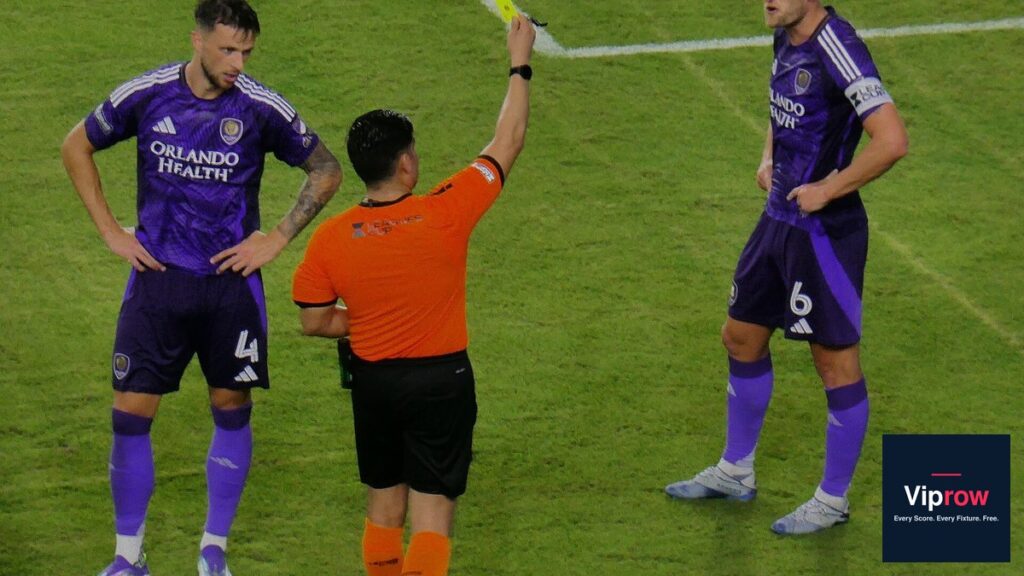
Every Offence That Earns a Yellow Card
Law 12 lists the cautionable offences in a few clear groups. The most common is unsporting behaviour. This covers a reckless tackle, a foul that stops a promising attack, and a deliberate handball. It also covers diving to win a free kick or a penalty.
Dissent is another major group. A player who argues with the referee by word or action can be cautioned. In addition, persistent offences bring a yellow card. A player who keeps fouling, even with small fouls, will eventually be cautioned.
Unsporting Behaviour and Dissent
Unsporting behaviour is the widest group, so referees use it often. It includes a tactical foul that stops a counter attack. Dissent, meanwhile, is about respect for the referee. A calm question is fine, while shouting is not.
Delaying the Restart and Leaving the Field
Players can also be cautioned for delaying the restart, such as taking too long over a throw-in or blocking a free kick. To see how these offences connect to the restart, read our guide to how football free kicks work.
What Is a Red Card in Football?
A red card is a sending-off. The player must leave the field at once and take no further part in the match. The team plays on with one fewer player, and no substitute can replace the dismissed player.
A red card can be shown in two ways. The first is a straight red, given for a single serious offence. The second is a red for two yellow cards in the same match. In that case the referee shows the second yellow, then shows the red. Either way, the player leaves, the team is short, and a suspension usually follows.
Every Offence That Earns a Straight Red Card
Law 12 lists the sending-off offences, and they are all serious. The first group covers dangerous play. Serious foul play means a tackle that endangers the safety of an opponent, or uses excessive force. Violent conduct means using excessive force against any person, even when the ball is not in play. Biting or spitting is also a sending-off offence.
The second group covers stopping goals by unfair means. A player is sent off for denying an obvious goal-scoring opportunity by handball, or by an offence that would earn a free kick or a penalty. However, if the offence happens inside the penalty area, and the defender made a genuine attempt to play the ball, the punishment is a yellow card instead.
Serious Foul Play and Violent Conduct
Serious foul play happens during a challenge for the ball, when the force is far too high. A two-footed lunge or a tackle with the studs up can count. Violent conduct does not need a challenge for the ball. A punch or an elbow off the ball is violent conduct.
Denying a Clear Goal Chance
Denying an obvious goal-scoring opportunity is often called DOGSO. The referee judges the distance to goal, the direction of play, and the position of defenders. If a goal was likely, and the foul stopped it, the player is sent off. For more on fouls inside the box, read our guide to how football penalty shootouts work.

Two Yellow Cards Mean a Red Card
Two yellows in one match equal a red. This is one of the best-known rules in football, and it creates real tension late in games. A player on a yellow must play with care. One more mistimed tackle, and the match is over for them. As a result, managers often substitute a booked player to protect the team.
The referee follows a set routine. First, the second yellow is shown. Then the red is shown. Both cards are recorded in the match report. The player leaves the field and cannot be replaced. The usual suspension for a second yellow is a one-match ban, although the exact length depends on the competition rules. Any cautionable offence will do.
Careless, Reckless and Excessive Force: How Referees Decide
Referees judge every challenge on a sliding scale. Law 12 gives them three words to use: careless, reckless, and using excessive force. Each word leads to a different outcome, so the choice matters a great deal.
A careless challenge shows a lack of attention or care. The player mistimes the tackle, but there is no real danger, so no card is needed. A reckless challenge is worse. The player acts with disregard for the danger to an opponent, so the result is a yellow card. Excessive force endangers the safety of an opponent, so the result is a red card.
The referee must judge speed, intensity, and intent in a split second. Two tackles can look alike, yet one is reckless and the other is excessive. That is why fans often disagree with a decision. To see how technology helps referees, read our guide to how VAR works in football.
What Happens After Yellow and Red Cards: Suspensions
Cards do not end when the match ends. After the game, the referee sends a report to the competition. The competition then applies the rules on suspensions. In general, a single yellow card in a match brings no ban on its own. A red card, on the other hand, almost always brings a suspension.
The length of a red card ban depends on the offence and the competition. In England, a red card suspension usually covers league and cup matches together. Yellow card bans usually apply only in the competition where the cards were collected.
How Long Does a Red Card Ban Last?
There is no single answer, because each competition sets its own lengths. A sending-off for two yellow cards usually brings a one-match ban. Serious foul play, violent conduct, spitting, and abusive language usually bring longer bans, often three matches.

The Premier League Yellow Card Rules: 5, 10 and 15
The Premier League adds its own accumulation rules on top of Law 12. They are set by The FA and apply only to Premier League matches. They are based on how many league games a player’s club has played, not on calendar dates.
The first threshold is five yellow cards. A player who collects five yellows in their club’s first 19 Premier League matches serves a one-match ban. Ten yellows, up to and including the club’s 32nd match, brings a two-match ban. Fifteen yellows by the last day of the season brings a three-match ban. Twenty yellows means a hearing before a regulatory commission.
It is worth noting what does not count. Yellow cards in the FA Cup or the EFL Cup do not count towards the Premier League total. However, a red card suspension does cover the Premier League, the FA Cup and the EFL Cup. For a closer look at another law that shapes Premier League games, read our guide to how the football handball rule works.
Sin Bins: A Third Option in Grassroots Football
Yellow and red cards are not the only tools. In grassroots football, there is also the sin bin. This is a temporary dismissal. A player leaves the field for a set time, and then returns. The team plays short while the player is off.
The system comes from IFAB. In March 2017, IFAB allowed national associations to use temporary dismissals at grassroots level. The FA chose to use them for dissent, to cut down on abuse of referees. As a result, sin bins now apply across grassroots football in England.
The referee signals a sin bin by showing a yellow card, and then pointing to the touchline. The player must leave the field and wait in the technical area. The time starts when play restarts. If the same player is sent to the sin bin twice in one match, the player cannot return.
How Long Does a Sin Bin Last?
In adult grassroots football, a sin bin lasts ten minutes. In youth football, it lasts eight minutes. The referee times the period and includes any lost time. The player can only return when the referee waves them back on, and only during a stoppage in play.
Yellow and Red Cards, VAR and the Referee’s Signal
Modern football adds video to the card system. VAR can review certain red card decisions. A straight red card can be checked, and a clear mistake can be corrected. However, VAR cannot review a second yellow card, because the Laws treat it as a caution, not as a direct sending-off offence.
The referee’s signal is part of the system too. The referee holds the card high, in full view, and points the player towards the tunnel for a red. The assistant referees help by flagging offences the referee may have missed. A clear signal avoids confusion, and a calm manner keeps the game under control.
Can VAR Overturn a Card?
VAR can recommend a review when a straight red card may be a clear and obvious error. But it cannot review a yellow card on its own, and it cannot review a second yellow. To learn how teams cope when a player leaves the field, read our guide to how football substitutions work.

How Players, Coaches and Fans Should Read Yellow and Red Cards
The best way to read a card is to ask three questions. First, what did the player do? Second, how dangerous was it? Third, has the player already been warned? The answers place the decision on the scale from careless to reckless to excessive force.
Players should treat a first yellow as a real limit. They should change how they tackle, avoid needless fouls, and stay away from arguments with the referee. Coaches should watch the count too. A player on four Premier League yellows near the 19-match cut-off needs careful management.
Finally, remember that the rules exist to protect players and to keep the game fair. When you see a card, look past the colour. Look at the offence, the danger, and the pattern. That is how yellow and red cards really work in football.